Friday, August 26, 2011

Madison, Wisconsin -A City in Quiet Turmoil

The next morning we left the Rochester area and headed east on Highway 90. At the border of Minnesota and Wisconsin we were surprised to see the Mississippi River.  Actually it is the upper Mississippi that we cross as we enter the city of La Crosse.  We stopped at the Visitors Center to see what there was to see and do in Wisconsin.  Wisconsin is known for its cheese factories and I would have love to stop at one, but they would have taken us off our beaten path.  This is also Amish country and that again would have been interesting if their hamlets were not so far out of our way.  Another point of interest was the Laura Ingalls Wilder society in the city of Pepin.  The Little House in the Prarie was one of my favorite books and I was glad to see where the story came about.

We also noted how important bike trails are to the state of Wisconsin.  We picked up a trail map and found that there are trails all across the state.  Actually, there are four trails: Great River State Trail, La Crosse River State Trail, Elroy-Sparta State Trail, and "400" State Trail.  The trail is 101 miles from Marshland and ending at Reedsburg. There are three tunnels that go under freeways or through mountains.  The trail is for fast travel with the surface made of fine limestone.  We took the brochure and put it in safe keeping for future ventures.  

We were eager to get on our bikes and do some riding.  When we got into Madison we found the Sheridan Hotel and got settled. We then changed into bike ware and got a map from the desk showing a bike route that passed our hotel and continued by the Lake Mendota.  It followed the lake trail and then went into the city through residential areas and back to the lake again.  We got on our bikes and drove out.  The trail was very popular with bikers and commuter traffic.  The difference is that bikers always wear the cute, colorful outfits and commuters wear what they are going to wear for work.   

It was beautiful day and the ride was terrific.  Riding by the lake we went by the beautiful avant garde Performing Arts building and by several county buildings with architecture from around the turn of the century.  The lake was a lovely pale blue and several fishing boats were out hoping of a catch.  The trail then led us into the city.  Unfortunately, there was a lot of repair going on and we had to stop and walk our bikes around the detours until  we finally got on the trail again and started riding.  There is a saying that when things go bad and you can't do anything about them, you go out and plant a garden.  Well, there were plenty things going wrong with the educational system in Wisconsin, and plant a garden, they did.  We rode next to a community garden that went for blocks.  These gardens were well cared for with plenty of vegetables and lots of flowers.  We saw several people planting and weeding and keeping them in great shape.  

 We left the gardens and followed the trail to a more rural area or perhaps a preserved area.  Here there were lots of trees and the trail meandered in and out of forest and thick vegetation.  It opened up to a community park with tennis courts and the lake house where you could rent kayaks and paddle boards.
We went over and chatted with the Life Guard who suggested a different route to use on the way back.
We had gone completely across the lake and we could see the capital building and the performing Arts  building from where we were.  The lake looked inviting and we would have taken a dip but the prospect of riding with wet clothes wasn't appealing.  We thanked the Life Guard and made our way to our new  path.

We went to the corner of the park and make a sharp left turn and went directly up the hill.  We were carving our own trail here and found the ride most interesting. The houses were all very unique.  They reminded me of houses in Palo Alto. Each had its own charm and lovely garden in the front.  In the gardens we found signs throughout the area asking to repeal the present governor, Rick Walker.  Most signs were pretty civil but some showed the frustration this state is going through with its governor. Time will tell how the next election will go.  We were facing a similar distaste in our own state of Florida.   

We followed the road near the lake until it got us back to the trail that we were on when we started.  Now we were on familiar ground and we set to peddling faster as we felt invigorated riding near the lake again.   This was a wonderful day of riding and we will remember Madison for making this bike trail a useful one for everyone.


Wednesday, August 24, 2011

Rochester, Minnesota – The Home of Mayo Clinic

We left the Birmark Inn at two in the afternoon after a good shower and lunch. The manager was most gracious, and he allowed as much time needed before checkout. We got on highway 90 heading east into Minnesota. We drove looking for a welcome center or a rest stop, but nothing came into view. What did come into view beyond the fields of corn were wind mills or I should say wind
turbines.

Windmills have been around since the early Greeks and Persians used a horizontal rotary windmill to grind grains. The invention traveled to China and India as well. The Windmills converted energy of the wind into rotational energy by means of vanes called sails or blades. In the pas they were used for milling grain or to pump water. The Horizontal-axis windmill was developed in Western Europe around the 12 century. Don Quixote fighting the windmill always comes to mind. The ones seen now are wind turbines to generate electricity. In 1974 ASA developed wind turbines technologies in use today. These include aerodynamic structural, acoustic engineering design capabilities. Looking out into a forest of white windmills turning in the light wind we have utilized this information to create and store electrical energy for farms, and towns throughout the west.

We watch as a huge truck as it approaches from the opposite direction hauling a large white blade that seems endless as it sweeps past us. The blades come in many sizes depending on the size of the tower of the wind turbine. Most industrial wind turbines have towers 164 ft. high and can generate 250 kilowatts of power with blades that are approximately 50 long. The huge turbines that you might see in the North Sea may be as high as 288 ft. and can generate up to 660 Kw of power. On the other hand, some ranchers can put in small turbines to produce just enough for their farm needs. Also some boats use wind turbines for their electrical needs or to use as chargers for batteries. Looking out into the planes of Minnesota we are amazed at how many turbines are in place like marching armies with rows and rows of turbines all turning gathering energy. This energy is linked by cables under the ground from each turbine into a larger cable that then is transported to stations to be dispensed or stored. Wow!

We were nearing our destination and typed in the Koa address into our Garmin Girl and she led us off the highway to a quiet pasture area where our Koa was located. This Koa was split in half by a public road so that the main office and bathrooms were on one side and the pool and tent and some RV sites where across the street. Out site was right next to the children's playground and next to the fence adjoining the street. We set up our tent and went to the pool that was being used by several families. It was impossible to swim laps so I brought my hand weights. I started with sit-ups on the lawn chair and then did my upper body weight routine. John had jumped into the pool and was engaged in throwing his football to some of the kids. He is pretty much like a kid himself and he enjoys getting kids all playing games. I happened to be wearing my blue Life Guard suit and all the time I was working on my weights, a little girl about the age of Berkeley my seven year old grand-daughter, kept looking at me with curious eyes. Finally, she asked, "Are you a real life guard?" "Yes," I said. "Only life guards get to wear these suits." Well, I wasn't really fibbing. I had to pass my life guard test in Hawaii back in 1964 in order to work summers at Palama Settlement.

When I had finished my weight regiment, I stood at the edge of the pool and put on my cap and goggles.

I blew my imaginary whistle and announced that the lane be cleared so the lifeguard could do her workout. Everyone looked up and automatically moved to one side of the pool as I dove in. It was great not having to bump into anyone as I did my routine of swimming. Soon John joined me and we had half of the pool to ourselves while everyone politely stayed and played on the other side. Nice!

After our workout we got to talking to the family that had a boy about three and the little girl about seven. They were from Madison, Wisconsin and were enjoying their camping in a large, top of the line Motor Home that was will to them from his father that had passed away. They were also given a cabin on a lake somewhere in Minnesota. They were not sure they were going to keep the Motor Home. She said that he should sell his Porsche that was just sitting in the garage most of the time and that they should keep the Motor Home. He clearly did not like that idea. But he did like the new VW Beatle that they were towing in the back of the Motor Home. He said that he actually bought it in Sarasota on line and got a great deal. Just then little Bobby got out of the pool and started running around the edge of the pool which was a no-no! So Dad got out and started chasing him around until he caught him and holding on to him, he jumped into the pool.

There were two other boys in the pool that John referred to as the Tons-of-Fun Twins. They were big and when they jumped into the pool, which was another no-no, they created a Tsunami of water that went outside the pool. One was a Down syndrome boy who kept bragging that he got to go to Special Olympics. He boasted that he was in China last year competing in wrestling. All the while he was talking the other boy kept tossing John's football as hard as he could and visa-versa. We kept out of the way and John patiently waited until they were done to get his toy. We then gathered all our equipment and said good-bye to our friends and went to change for dinner.

We drove to the near-by town called Marion. John was eager to find a Sports Bar where he could find out about a golf tournament. We located one across from a strip joint that was pretty vacant on a Wednesday evening. We sat at a table and ordered salads. My special request was that it be a GREEN salad instead of a white one. John doesn't care if they use iceberg or what- ever. I have found Iceberg salads are mostly water white. So when we both got great green leafy salads, we were most happy. The cute waitress said that they grow their own vegetables and herbs for salads and they never use Iceberg. I was impressed!

Since we were the only customers we had a chance to talk with our server who was a nurse at the Mayo clinic. She was only working part time as she was expecting her first child. Tonight she was just filling in for a friend who worked at as a bar tender. Nancy said that she felt like an indulgent child when she worked at the clinic with all the other nurses making sure she was eating well and taking care of herself. While Nancy was called to serve at the bar, we got to know Joanne who brought us our meal. Joanne had her arm in a cast. She was third baseman and she tried to catch the ball with her left hand to put the runner out and had her wrist pulled back and strained. She had to go to the Mayo clinic to get patched up. In spite of this injury, she was still good at being able to carry two plates full of food with her right hand .I wished that we had an extra day to visit the Mayo Clinic. I use the Mayo clinic on line service whenever I have a physical concern and feel that it is my personal clinic.


Tuesday, August 23, 2011

Sioux Falls – The Heart of America


We were now on the road heading for Sioux, Falls. We left Mitchell, South Dakota at one o'clock in the afternoon, and we only had fifty –six miles to go. We figured we would be there by at least two-thirty. That was a good time since we were planning to spend the night in a hotel and check in was after two. We found the Birmark Inn near the highway and settled into our room. John needed to use the computer to get reservation for hotels for the next few days, so I gathered all the dirty laundry and spent some time getting it done and tidying up the car for our next drive.


Around four we went to explore the city of Sioux Falls. The city was founded in 1856. The center of the city is near Falls Park showcasing the tumbling waters of the falls. The Native Americans were the first to see the falls and bring notice of it to the early explorers. An average of 7,400 gallons of water drop 100 feet over the course of the Falls each second. The minute we got out of our car we could hear the thundering roar of the Falls. We followed he walk through the park meandering around the red, rock boulders as we neared the bridge. The water was white as it cascaded over the red rocks. I took several pictures and a movie of the rushing water.
We walked across the bridge to the other side and entered a building that was once the beginning of a hydroelectric plant that would use the water as an energy resource at the turn of the century. It never panned out but some of the remnants are still in evidence. We followed the walk up stream to see if there were other falls farther up. Near the parking lot, we stopped and talked to two bikers who just finished their trek for the day. They were hot and sweaty and clearly had gone the distance in temperature of 92 degrees. John and I were eager to take a bike hike too, and asked them about their route. They said you could go for miles and miles and follow the river. It is purely a bike trail and you wouldn't have to cross any streets with cars. In places where there would be an intersection, you simply go under the road and where you cross the river, you simply go over the river on a bridge. We were very excited about that, and said we would plan to do it early the next morning.
We went back the way we had come and made our way to the car as we wanted to see down town and look for a place to eat. We headed a few blocks north and parked Moby Dick with his bikes and surfboards right on Main Street. It was a Tuesday evening and not much was happening down town. Most of the business for eateries here is done at noon. Citibank had moved its cardholder office to Sioux Falls from New York. This seemed to boost more business downtown. We found the McNally's Irish Pub. John liked it because it was Sports Bar and the only one open for evening business. We found a booth and ordered a light meal. We were the only customers in the joint, so we had an opportunity to talk to the bartender who was also our server.
Frank had lived in Sioux Falls all his life and outside of sports he was out of touch with the rest of the world. So John talked sports: Green Bay Packers, Cleveland Indians, and Chicago Bulls. He seemed to know all about these teams – who got traded, who the coaches were, how next season was going to go. I was done with my salad and was ready to chomp on my chicken burger. John ordered another beer and the talk continued. John started on his burger and I had a chance to jump in and ask Frank about what events that made the town jump. He said we just missed the Jazz and Blues Festival this last weekend, and a great St. Patrick's Day Parade, as there are lots of Irish here. "Oh," he added, "You would like the Art Walk right here downtown. Sculptures are put up during the summer and you vote for your favorite one on Facebook. This brings the artist some notoriety and funding. So when you are done with dinner, take a walk and check them out!" We thanked Frank for his advice and walked out to see the sculptures.
It is funny how sometimes you don't see things until they are pointed out? Well, we had walked up and down the streets earlier that night looking for a restaurant and didn't even see the sculptures. Now we went up and down trying to figure out which ones we liked the best. For me it was a toss- up between the girl with the Red Dress, or Goddess of the Grapes. I opted for the Goddess. John liked the Sand Hill Cranes and The Blind Shot Hit and he opted for the Blind Shot because it reminded him of when he played football.


Hit from the Blind Side

Goddes of the Grapes
 We walked around doing some window shopping and John was glad that the stores were closed when I spotted Haegle's Western Wear shop where there was a fantastic display of decorative boots. It was just what I wanted for Line Dancing! But alas, the store was closed. To take my mind off of buying western wear, John pointed to Minerva's, an upscale restaurant where we might get an ice cream and Kailua for desert. Again we were the only ones at the bar and although the request for ice cream had never been made to the bartender, he obliged and brought us each a bowlful, and we asked him to drown it in Kailua liquor. We got to talking to Eric, since he had nothing else to do. We told him about all the foreign kids that were working in the U.S. when we had so many people unemployed. He said that many of the U.S. kids go to Europe for the summer to do the same thing. Many are sponsored through their universities, so it's a good exchange as it opens the eyes of young people in this now global economy. We liked talking to Eric and would have spent the rest of his duty there talking about anything under the sun as he was most erudite, but we were getting a bit tipsy and had to get back to the hotel and get a good night sleep in preparation for our bike hike the next day.
The next morning we got up early, had a complimentary breakfast, and got a late check-out so we could enjoy our bike ride. We drove to Falls Park where we saw our biking friends the day before. John pumped up the tires as I got water and we were ready to ride. It was early so the heat index was still mellow. We got on our bikes and went downhill to the railroad crossing and beyond as we followed the river. At one time we went below under the underpass hearing the cars zipping above us. We had to go slowly as we neared a blind right angle turn. We circled around and were back following the river. Soon we approached a bridge and started going across when I saw John stop in the middle of the bridge. We both looked at the smooth water swiftly flowing down from a dam as smooth as Lady Godiva's hair. It was beautiful how smoothly it came down the smooth concrete panels and curl bubbling at the bottom.
I don't know how long we stayed watching the water but we had to finish our ride and we hadn't gone for a half hour. We hopped back on our bikes and followed the bike lane went straight up and kept climbing on the other side until we hit the levy. We road on the levy with arms in the aero bars as we settled down for a long ride for miles ahead. Off to the side there were hay lofts rolled up in circles like little loafs of bread. Looking closely I noticed that there was a mesh netting all around it to keep it together. Noticing these from far away in a car, I never would have seen the netting. I found this very ingenious on the part of the farmers. Also I noticed that the well for the water was at the end of a sprinkler such that the sprinklers rolled in a 360 degree turn as it watered the hay. If I were looking from a plane, it would look like circular crop circle.
Along the way we crossed a few people that were riding the other direction. One was a little, old lady that rode a bike with no gears and a basket in the front. She wore sandals and a floppy hat and a skirt. She was in her own world as she passed us humming a tune. Up ahead was a fast rider that passed John and I at a fast clip. He was wearing a light blue racing suit with a helmet and clip on shoes. He must have been going at least twenty-five miles an hour. When he passed us, he disappeared like a spec in the horizon.
The bike trail actually goes about 35 miles around the whole city. We were beginning to feel fatigue since we had not ridden for a while so when the trail turned to a rest stop we decided to stop and get a drink and asses our situation. There on the top of the hill near the port-o-potty was our peddling hero doing yoga exercises. He was stretching every direction and giving his full concentrative effort in doing so. I was feeling a bit stiff too so I did a few hamstring leg bend and arm stretches. John came back from the nearby woods, no port-o-potty for him especially near Romeo. He took a long drink and said, "Let's go back."eHe That was fine we me.
We turned around and rode around the corner and BAM! It hit us! We hadn't felt it before but now that we were facing the wind, we realized how easy our ride had been with the wind behind us. We quickly made a gear change and off we went feeling it in our quads a bit more than before. By getting lower in our aero bars we offered less resistance so we could combat the wind a bit easier. The good thing was that it was a steady wind and not gusty. Being high on the levy a sideward wind would easily pushed us over the edge. But for now we were going slow and steady against the head wind and making progress.
We retraced our tracks and by the time we got to the parking lot, there was the lady with the big hat having her lunch sitting on a near-by bench. We got off our bikes and drank the rest of our water. "Did you have a good ride?" asked the lady from the bench.
"Yes, but we didn't plan on the wind coming back," John answered.
"You must be new to these parts," she exclaimed pealing her banana.
"No, just passing through. We're from Road Bike Magazine. We go to every city and try and rate their bike trails," said John looking at me with a wink.
"Well, how do you rate us?" she asked flipping her banana peal into the garbage can.
"Absolutely fantastic!" John exclaimed hoisting his bike on the rack.
"Well, that's great news. I'm going over to the Sioux Falls News and let them know." She got on her bike, tucked in her skirt and road off into town.
We finished putting our bikes away feeling a bit guilty, but what the heck we meant no harm and besides it was a pretty fantastic ride!


Sunday, August 21, 2011

Mitchell, South Dakota – The site of The Corn Palace


1927


After taking our last pictures of Mt. Rushmore, we were ready to get on the road again. We went by Keystone, and if we could, we would have liked to spend the rest of the day there having fun at the Big, Thunder Gold Mine, Mt. Rushmore tramway and Alpine Slide, and The President's Wax Museum, but we had a day's travel to do and so we headed to Rapid City. There we had to skip the Black Hill Caverns, Dinosaur Park and Geology Museum; something to keep in mind for another trip.
We headed east on Highway 90 with miles and miles of corn fields in front of us. Our next destination point was Kennebec, a dot on the map but a Koa close to the road. We put the Garmin Girl to the task of finding it, and she lead us to a small hamlet off the highway made up of a restaurant, gas station, and a few silos and then the campground. We set up camp and because we were famished went to the restaurant for an evening meal. We ordered our meal and had a chat with the young, pretty waitress. We told her where we had been, and she explained that she had spent many a summer working at the hotel in Deadwood. In fact, some of her friends were the actors that played the gunslinger cowboys in the street scenes. Her career goal was to be a costume designer for theater. She was hoping to leave to go to Dakota Wesleyan University in the fall and was working this summer to pay her tuition. We wished her good luck, gave her a good tip, and drove back to our campsite.
The next morning we broke camp and headed east looking for a city called Mitchell that our friend Emil said we must see. He said there is a Corn Palace there that will "blow your mind". Well, I could do with a little popcorn right now as I nibbled on peanut butter crackers. Around ten in the morning we drove into Mitchell and found a Wall-mart where we resupplied our cooler and, got some fruit for breakfast. We asked a few people about the Corn Palace. Some people were enthusiastic, and they gave us good directions, some said that it was for the birds!
We headed to Main Street to find what Emil said "would blow our minds." Once we got on Main Street it was not hard to miss the Moorish Bulbs that set the building aside from other rectangular buildings in its midst. We parked on the street and walked to the Corn Palace our eyes widening at every step. The exterior was made of corn and it was in the process of getting a facelift. A group of young people were taking down parts and putting up other sections. It looked like an on- going activity.
We walked inside and saw bright lighted panels of other designs of the Corn Palace in the past. Apparently, the exterior gets a facelift every few years with local artist contributing their designs. We waited for our tour by looking at items at the gift shop which were pretty corny since everything related to corn. Soon there were lots of people milling around getting ready for the tour. We were all lead to the auditorium by our young guide. Down on the main floor which looked like a basketball court, there were many vendors putting out their wares for people to buy.
Our young guide explained that the first Corn Palace was built in 1892 and was originally called the Corn Belt Exposition. It was designed as a multi- use facility hosting stage shows and sporting events. It stands in tribute to the rich soil and agriculture heritage of South Dakota. The cost annually is $130,000. The exterior is entirely stripped down and new murals designed by local artists are put up every year. He pointed out the mural that surrounded the top of the arena, and the theme which was settlers working together with Native Americans. He also explained that the arena was used for basketball games by the Dakota Wesleyan University and local high school basketball games.
It was certainly an eye catcher for the city of Mitchell. We went outside and took more pictures before making our departure.


2011


Saturday, August 20, 2011

The Black Hills – A Special Place for Mt. Rushmore


We got up early the next morning and put the tent away even though it still was damp from the rain the night before. We were eager to go to Custer State Park and see the buffalo herds our Canadian friends talked about on the ride home from Deadwood. They had gone to see the Mt. Rushmore monument and circled around passing through Needles Highway then going to Custer State Park. They said if you get there early, you would see lots of wild life. So we hurried and packed and grabbed a Five Hour Energy drink and a quick breakfast in Deadwood and we were on our way.

We followed highway 385 down through Silver City and on to Hill City. That was a pretty easy drive. At Hill City we took highway 16 and the road began to change into a single lane with lots of curves. John had been experimenting using lower gears rather than use the breaks, so now was a good time to do this as the curvy road and changing elevations made him extra careful of his driving. At Spring Creek we began climbing to Harney Peak with an elevation of 7,242. We came to Sylvan Lake where we saw a sign advertising a climbing school. What a perfect place to climb with the interesting rock formations .Just beyond we saw the Needle's Eye which is a hole made by the wind on one of the slender pillars. As we drove on we came to our first tunnel. It was so narrow that only one car could get by. So we honked our horn and eased through. We continued slowly climbing. I checked the speedometer, and saw the needle at 25 and even lower if another car approached the other direction. We were wondering if our Canadian friends were laughing thinking of us on this skimpy road.


I checked the map and it showed that we had two more tunnels to go. This was getting to really be an adventure and we were on the edge of our seats. We were now on Needle's Highway built in 1922 planned by South Dakota Governor, Peter Norbeck. It is one of the most difficult roads on this planet. If this was in an amusement park, it would be the high attraction especially if it were on a roller coaster flying through the tunnels. For us going slow was just fine when we could see the thousand foot drop on the side and no shoulder if a car came at you from the other direction. We edged our way one tunnel at a time holding our breath in case we were face to face with someone coming the opposite way.
We continued driving slowly on Needle's Highway which got its name from the needle-like granite formations that appear to pierce the sky. Along the forest side of the road there were tepees made of wood throughout the forest floor. I was curious and found that they are called slash piles made by the forest rangers to create fuel breaks that reduce the intensity of the fire. Then the firefighters can go in safely and stop the wildfire. I had to explain this to John who could not afford time to sight see during this part of the trip. One of the things he did notice was the pigtail bridges in which the road looped around as it descended in a spiral form of a pig's tail. I bet Mr. Norbeck had a great sense of humor!

Finally, we got to Blue Bell Lodge and the road started to straighten out and flatten out as well so that in front was a grassy plain. We went to the side of the road and took a breather, had some water and peanut butter crackers. That seemed to revive John so he felt he was ready to see some bison herds. The forest rangers said that there were about 1.300 in the park this year. They control the herd according to the grazing availability in the park. I had the binoculars out looking for any kind of wild life. At this point I would be happy with a mule deer.


Soon we came to a road jam with several cars just sitting and not moving. We look out ahead and saw several donkeys on the road not planning to go anywhere soon. The park rangers said not to feed the animals so everyone was just taking pictures and looking at the burros as they came up and stood in front of the cars. Some even came to the windows and looked in so people were petting them. John took a liking to a little one and had me take his picture with it. They sure looked hungry to me but I want going to be the first to give one a peanut butter cracker. Water may have been alright but all we had in the cooler was Gatorade, and I don't think that would be good for them either. Besides, not far away there was a bubbling creek so water was not their need. The burros were not native to the park but were brought in to take people to Haney Peak. When that project was discontinued, the rangers let the burros free to roam the park. Well, if we didn't see any animals, we can at least say that we saw the burros!
We meandered around the burros who would not move off the road, and made our way with binocular in hand looking for the bison herd. John was just happy to be driving an easy, flat road. We finally came to the visitor's center and took a break. We told the park ranger that the only animals we saw were the burros on the road. He said that the temperature was in the high nineties and most animals go under the shelter of the trees when it gets hot. Even if some of the bison are shedding their winter coats, they still bet very hot at this time in the afternoon, and go to take a nap. Well, I could buy into that explanation. After all they were not in the park for our convenience. This was their home and we were the visitors. So we refreshed ourselves and got back into our air conditioned car ready to finish the circle and head to Mr. Rushmore.


We were now driving on Iron Mountain Road and climbing in elevation. John again was sitting hunched over the steering wheel with both hands gripping tightly choking it. There were hairpin turns going up and this time there were areas where a car could pull out and let the other pass. These roads reminded me of a road in France from a picture of the Tour De France where they tackle this road on bicycles. Here our Moby Dick was not a happy, camper especially when approached by a huge motor home or tour bus. It is enough to make you lose your engine oil from fright!


As we approached our first tunnel, we noticed lots of cars parked and people all around taking pictures. So we hopped out and did the same. It seemed that no one was in a hurry to attempt the tunnel any time soon. We were happy to admire the rock formations in these Black Hills and look out into the Badlands in the distance. And now to add to this scene, man came along and built these roads and drilled through the hills in an effort to claim them for himself. I don't believe the Native Americans would ever think of changing the make-up of the Earth. They seemed to think the Earth is not for us to change but to leave just the way we found it for future generations. Well, the Park Service says exactly that in their credo that I remember reciting when I became a Junior Ranger. White man, however, has made his imprint, and we were now ready to venture through the first tunnel.


Moby Dick sounded a loud honk to warn other vehicles that we were on our way in. It was dark in there even with the headlights on as we crept slowly through. You hear stories about people dying and coming back to life to tell about it. One of the descriptions that many of them tell is the part when they are going through a dark tunnel being drawn by a bright light on the other side. Well, this seemed just like that. As we drove on the light got brighter and brighter until when we got to the end the white light was actually blinding! Then we cross the threshold and it seems everyone on the other side waiting to cross the other way, almost gave us a standing ovation with a wave as we drove on.

We were not out of this road yet as we noticed on our map that we still had lots of curves and two more tunnels to navigate. We drove slowly around more turns and came upon another tunnel. A lady was standing in front of the mouth of the tunnel navigating with her hands as slowly a motor home inched its way through the tunnel. Above the cab of the motor home on the upper bed loft window there were four little faces with eyes as big as saucers as the motorhome eased its way out. You could see the celebration going on in the cab. Dad moved the vehicle out of the way and parked allowing Mom to reenter the motor home and maybe serve some glasses of lemonade.

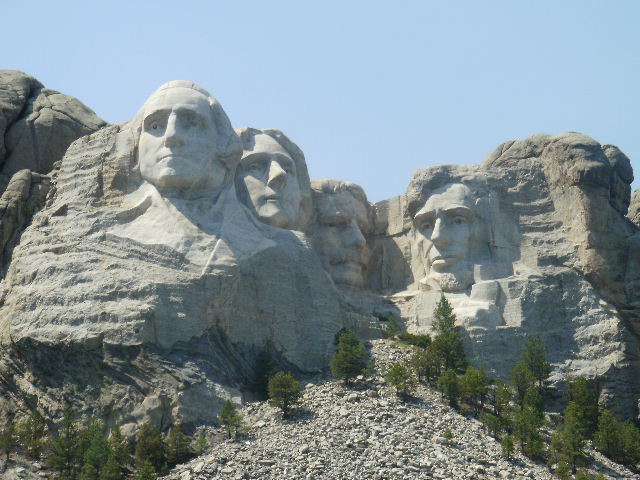
Now it was our turn to enter. We sounded our horn and slowly passed into the dark, long tunnel. We gave another honk from the inside just in case someone on the other side did not hear us coming. As we inched through the light kept getting brighter and brighter. Until, finally, we were out in the bright sunshine. Now we only had one more tunnel to go through. We drove around a few more turns to go before we saw our last tunnel. This last tunnel had no one waiting but you could hear people on the other side like they were having a party. We didn't want to waste any time if there was a party to go to. So in we plunged holding down our horn. I was camera ready as we approached the opening and I got the most miraculous picture of the four Presidents faces of Mt. Rushmore framed by the exit square of the tunnel. We joined the others who were at the observation area taking pictures of the monument.


We were eager to go to Mt. Rushmore which looked far away from the observation area. All the people around us had just come from there and were retracing our steps going the other way. We continued our winding way from an elevation of 4,000 feet going north. We knew we were getting closer as each turn we made the faces got larger and larger. Before we made out last turn into the parking lot we noticed a billboard with the rock carving of Crazy Horse with directions on how to get there. So we were curious enough to go and see what this was about. It was interesting that people thought the Native Americans should get some notoriety. The society that sponsored the welcome center for the Lakota Indians was charging $25 per person to enter the complex. We saw that we had enough cash for the Mt. Rushmore and not enough for Crazy Horse. So we did manage to take his picture and then went on the parking entrance of Mt. Rushmore.

Since this was a national park, I had our card ready to show that we were members and that would get us in for free. The parking attendant said that the park was free but the parking was not and we would have to pay $11 to park Moby Dick. Well that was alright with us and it looked like a pretty nice parking lot with plenty of room for cars and the motorhomes and busses were sent to another site. It was explained to us that the parking lot was run by Presidential Parking, Inc. This firm constructed the parking facility and continues to maintain it. Well, that was enterprising and it seemed to work In keeping the tourist happy. And that is all that matters.
We walked up the Washington Parking Ramp to the expansive pillared, and spotted the restrooms on the left and the Information Center on the right. It was a matter of urgency that we visit the restrooms after our perilous ride. Then we went into the Information Center. We were just in time to see a film on the construction of Mt. Rushmore. We found out that idea for a monument Duane Robertson, a South Dakota historian. He wanted to see western folk heroes carved out of the needles. He thought it would be great for tourism. He approached Guyton Borglum a well, known stone sculpture who had done sculptures at Gettysburg. Borglum came to the Black Hills and said that the Needles structures would not support the sculpture process. He noticed the large outcrop of rock that was most pronounced and said that Mt. Rushmore would be more feasible in that the rock faced south and would get the most sun through the day. It was Borglum's idea to have four important presidents to give it more national focus. He chose the four presidents because of their roll in preserving the union and expanding the territory: Washington, being the first president; Jefferson, Louisiana Purchase; T. Roosevelt, established the National Parks; Lincoln, Preservation of the Union.
After they got financial approval through the government, thanks to Calvin Coolidge, the film explained that the project began in 1927 and ended in 1941. It cost $989,992.32 and hired 400 workers to dynamite and jackhammer. Borglum had made small miniatures of the faces of the presidents to see how they would react to light and shadow. Then he made 30 foot tall models in his studio to use as a guide for his colossal sculptures. These models were 1/12 of the finished product. The workmen were lowered from the top of the rock which was the height of a 50 story building. They were lowered using iron winches in a special boson chair. Once the pointer verified the position, the workman would drill little holes with a pneumatic drill to insert bits of dynamite and remove extra rock to within 3 inches of the finished surface. Sometimes Borglum had to change his design because of the inconsistencies of the granite, but in spite of this he ended up with a magnificent finished product.
Borglum died at 73 not able to finish the project that would have continued the sculpture to the waistline of each president. He also wanted to carve out a large room behind the sculpture to be called "the Hall of Records" and would store important documents like the Declaration of Independence and U. S. Constitution, and the Bill of Rights. But since the Second World War had begun and the money dried up, his son was told to pack everything away and leave the project as it was. In 1998 to fulfill her father's wish, Mary Ellis Borglum Vhay, Borglum's daughter found a way to bury a teakwood box in a titanium vault at the entrance of the hall. The box contains 16 porcelain panels bearing the words of the Declaration of Independence, the U.S. Constitution and the Bill of Rights. It also includes the panels containing the biographies of the presidents and information about how and why Mount Rushmore was carved
After the film we went into the museum where we could see the tools that helped to sculpt the colossal sculpture of the four presidents. The actual studio sculpture was there showing the positions of the sculpture from which Borglum could figure the exact placement of each part of the face and make mathematical calculations for his pointer. We saw the winches and straps and harnesses that the workmen used. It must not have been an easy task to go down the mountain and drill. These men were daredevils who risked their lives. The project took fourteen years and went through the hard times of the depression when money was scarce. The project never stopped and it became a source of national pride when the country needed it most.
                                                                           

Now we were ready to see the real thing. Along with many people from all over the world and lots of families with children we walked through the hall of flags to the amphitheater where we could get a good view and take pictures. You simply have to be there to see the awesome size of the sculpture. Each head was 60 ft. high, each eye was 11ft wide, each nose was 20 ft. long, except that Washington's was 21 ft. long, and Washington's mouth was 18 ft. long. Talking to one of the rangers, he said that maintenance is a continuing job especially if there are cracks that form. They have to find a way to seal them so that water does not get in and turn to ice in the winter which would make the crack expand. Although we would not be there at night, we heard that the laser light show with patriotic music was a highlight presentation of the visit.


The park has some walking trails that people can take and one of them is to the Indian Village. There people can learn about the Lakota Indian heritage by exploring the history of American Indian tribes who had populated this land for thousands of years. It is interesting to note that Mt Rushmore to the Indians was called "Six Grandfathers" and was on the route that the Lakota leader Black Elk took in a spiritual journey that culminated at Harney Peak. The mountain had been given many names by settlers as they moved west, but it was not until 1885 when a prominent lawyer from New York came to the Black Hills to do some prospecting that the mountain was named after him. Charles E. Rushmore probably had some good friends in the newspaper business that publicized his christening of the mountain with his name and plastered it all over the news! The great turn of events is that now Mt. Rushmore has a lot more meaning than just a person's name.


Tuesday, August 16, 2011

To Deadwood or Bust!


We got up the next morning and had a light breakfast joining Emil and Angelina for coffee. We then broke camp with Emil and Angelina going to Yellowstone and we going the opposite direction to Deadwood, South Dakota. Emil said to make sure we see the chair where Wild Bill Hickok got killed and to make sure we see the Corn Palace in Mitchell. We told them that we would keep it in mind and showed them a map of Yellowstone and showed them that they would save time if they entered from the west entrance of the park. We said our good byes and got ready to get on the road again.


We picked up highway 90 and followed it across Montana. The planes were dotted by large ranch houses that were more like estates than what you would see out in the range. We continued to see the line of trees where the river flowed at the base of the hills. Near the border to South Dakota a large sign pointed out the site of Custer's Last Stand near the Little Big Horn River. Apparently, Sitting Bull had formed a Sun Dance alliance between the Sioux and the northern Cheyenne. He had a dream that he saw "soldiers falling on his camp like grasshoppers from the sky." A scout had warned Custer about the great size of Indians waiting to attack, but Custer felt he could surprise them while they were in their tepees and then they would scatter and run away. He underestimated that the Indians would stay and fight. You might say the Indians had a good cause to defend their land. The American Government made the Treaty of Laramie in 1868 with the Lakota Indians that said they could keep the land in the Black Hills as they believed they were sacred. Then prospectors found gold in the Black Hills and the Government went back on its word, and decided to put all the Indians in a reservation in Idaho. So the Indians grouped together and declared war.


We continued to South Dakota and the Black Hills. After passing the border we noticed the South Dakota welcome center with a monument of a Tepee made of tall concrete pillars. Inside the room was decorated with many panels about the history of the area and brochures about the Deadwood and the Black Hills. We picked these up and looked for interesting sites to see when we reached Deadwood.

As we read more of the brochures John got excited about visiting this frontier town. This was the site of many Westerns that we grew up watching on our little black and white T.V. sets. In fact they still had some of the sets they used in these westerns set up at the entrance of Main Street. We read that Wild Bill Hickok and Calamity Jane lived here. The town of Deadwood sponsored re-enactments to draw tourist to the town. John read that there were to be reenactments of the shooting of Wild Bill Hickok, shoot outs in the street, and a reenactment of the trial for Jack McCall who shot Hickok while he was playing poker. Life in this lawless town seemed to hold a special interest to John and I would venture to think he might have lived here in another life.

We had no idea where our Koa campground was as we neared the town of Deadwood, so we gave the address to the Garmin Girl and listened to her directions. She led us right through Main streets past the movie sets and on to the saloons and court house, hotel, and museum. We continued out of town up a road leading to a mountain, and then she suddenly said turn right to your address. Sure enough we saw the familiar Koa sign and turned in. After introducing ourselves we went to our campsite that was situated on a hill overlooking the pool. It was a pretty flat space below a cabin that was not rented. There was plenty of privacy, close to the bathroom, and only a little climb.
We set up our camp and went down to join the swimmers below. There were three families from Toronto, Canada who were traveling the west. Everyone was excited about going into town using the Koa shuttle and we signed up to go as well. We got dressed and met the shuttle leaving at five in the afternoon. This would give us time to get to see the major sights and some of the re-enactments that were scheduled that evening, and find a restaurant for a steak dinner.


We looked for the Number 10 saloon where the first re-enactment of Wild Bill Hickok playing poker. It turned out to be more of a story telling rather than a re-enactment as the two actors took turns telling the story of that fateful night. Apparently, Wild Bill usually sat with his back to the back wall but today he sat on a chair with his back to the door. He repeatedly asked the player across from him to change places with him, but he refused. Well into the game, Jack McCall walks in the door and aims his handgun at Wild Bill's head and down he goes holding a pair of aces and a pair of 8 in his hand. This hand will forever be known as the dead man's hand. The actual chair he sat in on that fateful day is right above the entrance door just like Emil told us.


goodie-goodie girl and didn't meet with the hard edge, drinking, tobacco smoking, swearing Calamity Jane described in her bio, but she sure could sing and that's why she probably got the part.
We got our pictures taken with the actors and then went to see the rest of the town. We found an old saloon where we took more pictures and found a great restaurant where we would have dinner later. For now we had to go to the White Hotel and wait for the re-enactment of the gunslinger shoot out to be performed out in the middle of the street. We sat on the curve near a family from the Netherlands who had seen many westerns on television. They were just as excited as us waiting for the big event to happen. We knew that it would be a class act as we saw the actors get wired for sound and the large speakers were set up so everyone could hear what was going on.
The main actor who looked like Polonius dressed in Western wear taking a break from Shakespeare Theater Troop. In his finest drawl he explained about the notorious reputation Deadwood had as a lawless town filled with miners, ladies of the night (prostitutes), gamblers and sharpshooters eager to show how fast they could draw their guns. He had a little bag that he would shake every once in a while during his overture and that kept us wondering if he had gold pieces in his bag. They were gold all right but they were stars. As he held one up he said he needed some deputies and went around to all the children and gave them a star. When he came to us, John said he qualified to be a deputy. But he was passed right by until he kept yelling that he indeed wanted to be one. Finally, "Polonius" turned and threw him a star that caught and proudly put on his shirt. After he had run out of stars, he gathered the deputes together and had them raise their right hand and say the pledge: "I will promise to up hold the laws of Deadwood, so help me God." Then he sent all the little children back to their parents all admiring their stars.

Now the show was ready to begin and I looked at my camera and saw that the battery had gone dead. Well, use your imagination as I tell you how it went. Three gunslingers rounded the corner and were walking and bragging holding each other up having just left the saloon with a bit more drink than they needed. They were bragging how they could hit a whisky bottle on a pole fifty feet away. Although they were wired for sound, it was hard to understand them as they slurred their speech. Around the corner down the street another gunslinger stood and yelled the name of the bragger, Sony McCoy. The other two braggers took off and Sony had to face the opponent alone. Now this challenger was not standing all too steady either, but he was bold enough to challenge Sony McCoy the hottest shot in town. They both held their hands hovering over their guns as "Sheriff Polonius" counted to three. The real blanks were shot startling the crowd and Sony went down. Sony commenced to do a dying scene that lasted about five minutes that would have impressed Shakespeare himself. Finally, when he could jerk no more, his two buddies dragged old Sony behind the building while the Sheriff took the challenger off in handcuffs.
After all was done the actors came out for their bows and to have their pictures taken with the audience. We were told that they do this charade every day of the week and that's what keeps the people coming to Deadwood. The last re-enactment was to be the trial of Jack McCall who killed Wild Bill Hickok with plenty of bi-standers at Saloon N. 10. This trial would take place in the courthouse at 8:00 P.M. We were hoping to catch that one too, as we heard it was like the Rocky Horror Show where the audience takes part as the jury and the people in the court house get to say what they think. We thought we would go and have dinner and hopefully finish in time for the trial.


We went to the Deadwood Saloon for dinner and we were told that it would be about fifteen minutes before they could seat us so we took pictures in the lobby and downstairs at the bar. We were finally told that our table was ready and we ordered the best prime rib with all the trimmings topped with a bottle of fine wine. John was still wearing his star and the waitress referred to him as the "Deputy Sheriff John" and gave us extra bread and large salads.
Well, by the time we were done, the trial was over and everyone was filing out of the courthouse. They were all disappointed though they knew that McCall would be acquitted. Some who were following the trial of Casey Anthony Trial in Florida said that she should not have been acquitted either. As history put it, McCall was acquitted because Deadwood was not a legitimate town. The Black Hills territory legally still belonged to the Lakota-Sioux Indians. So no legal decision could be made in the town. The authorities caught up with McCall in the Dakota Territory and put him on trial again and this time they convicted him and hung him for the murder of Wild Bill Hickok.
We all walked to the bus stop and got into our bus and headed for camp. That evening everything was peaceful and quiet, a contrast to the bustling town below. It was a lovely cool night, and we could hear the soft rain tapping on the rain shield of our tent. It didn't take long to be in dreamland…


Saturday, August 13, 2011

Sheridan, Wyoming – The home of the WYO Rodeo!


We drove on Highway looking for a welcome center, but the best we could do was to pull out of the highway at the welcome billboard for Wyoming. We needed to stretch our legs so we went over to the billboard and had our picture taken. Just as we pulled over another car full of girls stopped and wanted their pictures taken too. Then a truck full of hay rolls came and stooped too. We were looking like a parking lot. We chatted with the girls who were on their way to Colorado. Soon we were on the road again.


About twenty miles from Sheridan, we let our Garmin Girl guide us to our KOA. We were told that we did not have site with electricity, but we could use the electricity from site number 2 a few sites down to blow up our matrasses. That was fine. I plugged in my long orange extension cord, sat down in the shade and went to work. Halfway into pumping up the second matrass, a green pickup drove up to the camping spot. The fellow called out from the car. "Shade is at a premium see!" I looked up and said I would be done in a jiffy. John went over and chatted with the couple for a few minutes and I was done. I told them they were welcome to use my electric cord for their matrass as well. They said thanks and began getting their tent placed in the shade.


As we continued to work and set up our tent sites, we continued to chat with Angelina and Emil who came from South Dakota. We told them that we were planning to go to the rodeo. Emil got really excited about this, especially when we told him that we had never gone to one before and this would be our first, honest to goodness RODEO! Emil said, "You will love it and you will never be the same!" They had come to Sheridan for the rodeo as well and then would be going to Yellowstone. Emil was a cattle rancher who raised Angus cattle in South Dakota. Angeline was a nurse practitioner in the cardiology department. It got to be a stressful job so she set up her own nail spa, and she's happy as punch!
We each set our own table for a light meal and they offered us wine with dinner. I offered a coffee cake which I bought at the Family Kitchen in Billings. Upon finishing dinner, we found that none of us had tickets, and we decided to leave early in case we had to stand in line. So we headed out to the Sheridan Fairgrounds. There we were pulled into a parking lot by a boy scout who charged us five dollars and directed us into a spot. The lot belonged to a medical building that also treats emergencies. We thought that was odd, having a medical building near the Fairgrounds, but we were reassured of the reason later on.


We got out of our car, grabbed some water bottles, and followed the crowd toward the fence. You had to make yourself very skinny to edge yourself between the fence and the post, obviously this was the back end of things. We found ourselves where the contestants keep their horses and some were entering through the special entrance for participants. I was glad I wore my old tennis shoes. Boots would have been better, though my boots are only for line dancing and I wouldn't want to wear them in this area with mud and horse poop. No one else was looking down but me as the cute horse girls were bringing in their horses. I looked up and camera ready, asked If I could take their picture. Then the Rodeo Queen walked her horse over and John asked to have his picture taken with her. She said, "Why, shuh thing!"
We then walked around to the ticket building and found a line of people snaked all around serpentine passed the food stands and beyond. We followed the line as it led to the ticket booth. As we rounded the corner we saw a big sign that said, "SOLD OUT." Emil said, "Oh, no. Now we won't be able to see the rodeo." Angelina and I looked at each other and said, "Not if we can help it!" and rushed past the crowd that was heading for the last bleachers. We climbed up like we knew what we were doing and looked for empty seats. Well, by now all the seats seemed to be taken. So we made our way to the very top of the bleachers and there seemed to be standing room only. We were fine with that because you could see everything from there, and we were not in the sun like he people across the way who were baking in the Sheridan sun.
From the very start this event was a state of the art. They had a jumbo screen in case you missed something exciting, they would show you again. The master of ceremony spoke with a cowboy drawl and explained everything real good. He began introducing the color guard and they marched to the middle of the ring. Then he introduced a trio of singers who sang the national anthem in three voice acapella that brought down the house. Finally, he introduced all the dignitaries that rode up in their beautiful horses including the Rodeo Queen that graced us with her picture. After a standing ovation everyone sat down…except us, but that was OK.


The first event on the ticket was the Indian Relay. Today, since it was the last day of the rodeo the events were the finals of the last three days. So these were the best contestants and boy did they look eager. They came in running with their teams: thee horses, and three handlers. There were four teams of riders and they all had wonderfully clever Indian names like Spirit Moon, Thunder Cloud, Roaring Bear, Brave Wolf, and Star Dancer. They were bear chested but with painted designs on their chest and on their horses. The horses were eagerly prancing about but were not too eager to get ridden. Since they had no saddles these horsemen had to great riders to stay on the horse.
They all lined up and even if they were not all ready the bell would ring and handlers would hold the horse as the rider grabbed the main and swivel himself on the horse and off they would go around the track. The Jumbotron screen would focus on them all around so the audience could see who was ahead as well as the caller who made the ride even more exciting. When they came around again they would leap off their horse and jump on the next one and off they would race again! In some cases if the rider did not get on the horse, the horse would take off and race without a rider. The final time the third horse that had been waiting would take off with the rider and the race would go on. In one case the horse gave such a hard time to his rider that even if he was way ahead, he pushed his horse so hard it all most passed all the other horses in the race but ended second. It was so much fun to see how the relay worked and how magnificent the riders were as they rode so fast and furiously around the dirt track. When the awards were given, the winner graciously took the mic and dedicated his win to his brother who was recuperating in the hospital.
The next event was the steer wrestling which is a pretty fast event. It starts off with the wrestler cowboy, the "bulldogger" and the helper known as the "hazer" who keeps the bull near the wrestle. They both wait and give the bull a head start until the bull hits a line in the arena called the "score line" then both cowboys take off after the bull and as soon as the bulldogger gets close enough, he jumps on the bull and grabs it by the horns. He then presses his heels into the dirt for leverage and "BOOM" down goes the bull. If he does this the fastest and wins some money, he gives some to the hazer. That way they work as a team. After the bull is down for a while he is then released and is chased by a pretty cowgirl to the far end of the arena. All the contestants did pretty well at this event and the best one was the one that could do it the fastest. It also helps to have a good quarter horse that can help the cowboy get to the bull fast.
The next event was the team roping event. This is the only event when who cowboys work together. This again is a timed event and it helps to have a good quarter horse. The lead horse is usually bigger and stronger and the "heel" horse is more agile. The event begins with the bull getting a head start, then the lead horse goes and the cowboy lassos the bull around the head and turns him around so the heel cowboy can rope him around the legs. When both ropes are held tight then the time is stopped. Unfortunately, there was only one team that was successful of all the teams of cowboys. In most cases the bull would not get roped and would run around happily seeming to tease the cowboys and start running for the exit pursued by the pretty girl. That was pretty funny to us new to rodeo antics.


Now they were getting ready for the Saddle Bronc Riding event. They were having some trouble getting the wild horses ready, so to kill some time the announcer told a story of how the Native Americans chose names for their children. He said he got this story from a Comanche chief. As it was told to him when a baby is born, the father looks out from his teepee and whatever he sees will give him the name for the new baby. When his daughter was born he, pulled back the flap and saw a swan swimming in the pond. So he named his daughter, Swimming Swan. When his son was born, he looked out and saw a dog on top of the other. So he named his son Fornicating Dog. (F***ing Dog). For a moment the audience was quiet then they got it and exploded in a roar of laughter.
The announcer spoke a lot about the Native Americans in this part of the United States as a horse nation. The Spanish Conquistadors and settlers introduced the horse to the new world and the Native Americans realized the importance of this animal in their lives. The horse made it easier to follow the buffalo herds and kill the ones they needed to sustain them through the winters. They learned to breed and increase their numbers such that when the American settlers started coming across the plains there were herds of wild horses in the West. Since the Native Americans have been put in reservations and changed their way of life, being a horse nation continues to still be a big part of the Native American way of life. He made it a point that the western cowboy owed a lot to the Native tribes for their horsemanship.
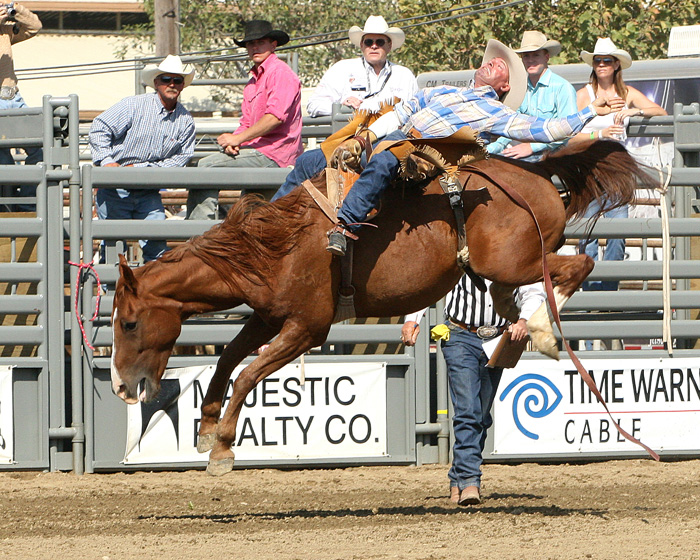
By now the horses were all settled in the chute and the contestants were ready. According to some sources, Saddle Bronc Riding is the classic event. It requires the balance of a gymnast, timing of a springboard diver, and grace of a dancer. Emil explained to us that the rider's feet must touch the horse's shoulder on the first jump out of the chute. If he fails to do this, he is disqualified. He holds on with one hand to the saddle horn as he attempts to place his feet over the horse's shoulder a split second before the animal's front feet strike the ground. As the horse bucks the rider bends his knees and finishes with a spurring stroke with his spurs near the back of the saddle then he snaps his feet back to the horse's shoulder as the animal touches the ground. Technique is most important and of course the cowboy has to stay the regulation time on the horse for a good score.
Everyone was excited for the first cowboy to take his turn. The ride was a good one and it scored in the 80s. The next two contestants were DQd, but then the excited announcer said this ride was the best he had ever seen. We all looked on the Jumbotron screen for the score and it came up 90! The announcer kept up his excited talking and he put the ride back on the screen so we could all see how great it was. Well, to us they all were fantastic but the judges know just what to look for and we have to take their word for it. No one else scored higher so we had our winner.
The Tie Down Roping event went pretty well for most contestants. They let the bull go first then the cowboy goes after the bull and ropes him and his horse hold him in place while the cowboy jumps on the bull and ties his feet together. The bull plays dead for a while, they seem to know how the game is played, then the bell rings and the assistants untie the steer and he gets up and runs to the exit being chased by a pretty, little cowgirl.
Now it was time for the girls to take the arena. The first event for women was the Barrel Racing. This is a timed event in which the competitor enters the arena from a 3:00 location circles around the barrel at 6:00 location then goes across to a 12:00 location circles the barrel and goes to the 9:00 location then goes off at 3:00 exit. All the turns around the barrel must be counter clock wise and if the horse goes the other way, the contestant has to do it again correctly. Whoever does the clover leaf figure the fastest, wins. This event started in 1948 in Texas by women who thought they would add a bit of femininity to the rodeo. It has become a lucrative sport for some. The National Finals pay out over $50,000. We watched as the four participants got their turns around the barrels. Only one succeeded in doing the figure perfectly. The rider and the horse had to work together as one to really make it perfect.
The next event was the exhibition riding also done by the girls. There were three girls in this event. They each took turns riding around the arena showing their stunts as they rode around as fast as the horse could run. They looked like ballerinas on horses doing arabesques and turns on the saddle. One jumped off the ground and swiveled over the saddle and jumped on the other side all while the horse was riding about thirty miles an hour around the dirt arena. Each time they had their turn again, they came back with more difficult tricks. This is an event you would see at the Wild, Wild, West Show. The finale the rider stood on her saddle and unfurled and large American flag that waved behind her as she rode. This brought the crowd to its feet.
This event got the crowd ready for the big event of the evening, Bull Riding. Rodeos began on cattle ranches and cattle drives in the Old West. Most of the events reflect what cowboys do on a ranch, such as roping, and taking down steer to brand them. Bull Riding is not one of them and some think you have to be nuts to ride a bull. Bulls basically do not want riders on them and they will buck anyway they can to get the rider off. Each bull has a unique way of bucking. Some spin around in circles in place bucking as they turn. Some buck in place and add a jump or kick as they spin. And still some jump side to side or lunge forward to make it difficult for the rider to stay on. The rider has to be agile, coordinated, have quick reflexes, and especially a good attitude. Emil noted that the successful riders are usually small men that have low center of gravity and can move compactly as the bull moves. The rider has to stay on the bull for 8 seconds. The score comes from his control on the bull and the bull's style of bucking.
We were excited to see the first contestant as he was shown on the Jumbotron getting his hand would around with rope. They did not wear cowboy hats but helmets like football players. When he was ready, he gave a nod with his head and they would open up the chute. That was the cue for the bull to start his bucking. Most of the bull riders never made the eight second mark, except one that rode a ferocious looking bull. When he jumped off, you could see that he was a small man, more like a kid. The announcer said he was five foot two which almost as small as I am. The bull on the other hand was huge by comparison. So you had to admire the cowboy's courage.
At the end of the rodeo all the flags of the many sponsors were carried around by riders on magnificent horses as they paraded at a fast gallop in front of the audience. Music was a big part of the rodeo and the announcer used the music to get everyone excited especially now when the sponsors were given tribute. You could see that it took a lot of money and organization to put this rodeo together. We were very impressed at the showmanship and the way events went without a hitch. Even if someone got hurt a golf cart would come out and get the contestant off the arena so the show could go on. Now we understood why they had a hospital right next door for quick attention.
The Rodeo was over but the evening was not done. Down town Sheridan had blocked off Main Street where the celebration would continue with dancing, eating, and games. So we said good bye to Emil and Angelina and said we would see them at the street party. When we got there the party was already underway. There were bands playing at both ends of the street and games and food and lots of beer in between. We walked the whole length of the street and did some window shopping at some of the western stores that were opened for business. We got to one end and heard familiar Rock and Roll music with people dancing and having a great time. When we got to the other end, we heard "Louisiana Saturday Night" and we got out there and joined the group of energetic dancers.


By the time we got home we felt we had put in a full day. We met up with Emil and Angelina who said they had been to the street party and had sampled some of their Indian Tacos, which I am told is a stable food at Rodeos. Well, Emil was right. Our life would never be the same after experiencing a Rodeo! Your life changes every time you learn something new and we learned a great deal not only the fantastic feats performed by this select group of extraordinary people, but by the spirit of the event. This was not lost among the performers, audience, or sponsors. Homage was given to the Scholarships given to college bound students, the Therapeutic Horseback riding for children of Disabilities, Animal Welfare, and Recognition of our fighting men and women in Iraq and Afghanistan, and Recognition of Native American Horse Culture. For us the great benefit was getting to know Emil and Angelina who we have grown to appreciate and will keep as good friends.